GT Canon

Family overview
- Condensed
- S Light Italic
- M Light Italic
- L Light Italic
- S Regular Italic
- M Regular Italic
- L Regular Italic
- S Medium Italic
- M Medium Italic
- L Medium Italic
- S Semibold Italic
- M Semibold Italic
- L Semibold Italic
- S Bold Italic
- M Bold Italic
- L Bold Italic
- S Heavy Italic
- M Heavy Italic
- L Heavy Italic
- S Black Italic
- M Black Italic
- L Black Italic
- Narrow
- S Light Italic
- M Light Italic
- L Light Italic
- S Regular Italic
- M Regular Italic
- L Regular Italic
- S Medium Italic
- M Medium Italic
- L Medium Italic
- S Semibold Italic
- M Semibold Italic
- L Semibold Italic
- S Bold Italic
- M Bold Italic
- L Bold Italic
- S Heavy Italic
- M Heavy Italic
- L Heavy Italic
- S Black Italic
- M Black Italic
- L Black Italic
- Standard
- S Light Italic
- M Light Italic
- L Light Italic
- S Regular Italic
- M Regular Italic
- L Regular Italic
- S Medium Italic
- M Medium Italic
- L Medium Italic
- S Semibold Italic
- M Semibold Italic
- L Semibold Italic
- S Bold Italic
- M Bold Italic
- L Bold Italic
- S Heavy Italic
- M Heavy Italic
- L Heavy Italic
- S Black Italic
- M Black Italic
- L Black Italic
- Extended
- S Light Italic
- M Light Italic
- L Light Italic
- S Regular Italic
- M Regular Italic
- L Regular Italic
- S Medium Italic
- M Medium Italic
- L Medium Italic
- S Semibold Italic
- M Semibold Italic
- L Semibold Italic
- S Bold Italic
- M Bold Italic
- L Bold Italic
- S Heavy Italic
- M Heavy Italic
- L Heavy Italic
- S Black Italic
- M Black Italic
- L Black Italic
- Expanded
- Mono
- Light Italic
- Regular Italic
- Medium Italic
- Semibold Italic
- Bold Italic
- Heavy Italic
- Black Italic
Subfamilies
- Standard S LightSo let us think of designers as those who constantly operate on the edge—whether with and on forms of recognition, or by allowing in the different, which fills the constantly repeating cascade of differences (from sensuality to imagination, from imagination to memory, from memory to forgetting, and finally to creative power (and then the whole thing starts all over again)).
- Standard M LightIn the one the principles are palpable, but removed from ordinary use; so that for want of habit it is difficult to turn one's mind in that direction: but if one turns it thither ever so little, one sees the principles fully, and one must have a quite inaccurate mind who reasons wrongly from principles so plain that it is almost impossible they should escape notice.
- Standard L LightQuoting is a technique of remembering. When we quote, we conjure up the past. We bring a text or an image from another time and place into a new environment. Remembering is a transformative process: what we remember is altered by adding, omitting or rewriting. The house is now red.
- Standard S Light ItalicWhat are the consequences? On the one hand, the design of the self. The device-ification of our bodies does not begin with chip implants, artificial intelligence and the semi-automation of intellectual work, but earlier and more decisively through this very intertwining of design and the various modes of supposed self-discovery.
- Standard M Light ItalicOnly that is limited can invite, can expand and intrude, or be intruded upon. No boundaries, nothing to transcend? At least nowhere to stay. Wandering does not leave any traces as long as it keeps up with the wandering of time.
- Standard L Light ItalicEvery face is different, and every face is the same: it reveals not only itself, but the generality of its essence. Hence, every face is both singular and plural: this face, and the category of face. To call something a face is to give it agency, to acknowledge that it meets us.
- Standard S RegularSince design means composing contrasts, creating tension can be a consequence. It’s not inevitable though. Contrast is no guarantee that tension will emerge. Quite the opposite. Tension is a rare commodity. Too much,and it dissipates. Often, the sweet spot lies in drawing the bow just far enough that it does not break.
- Standard M RegularAs in thought: a phrase balanced on its referent, meaning slipping just out of reach, suspended between the known and the not-yet. Balance is the architecture of instability—made durable through time. Balance is not a matter of equality but of energy.
- Standard L RegularOne of the great challenges in typography awaits both the typesetter and the type designer in the same place, and it concerns writers no less. It is not only the not-so-well-tempered poster that requires the right use of tension. It is especially the longer texts whose harmony and carrying power can be sustained only by maintaining tension.
- Standard S Regular ItalicWhatever is scaled inevitably changes. The morphology of insects versus that of humans. The differing stability of small and large load-bearing structures in architecture. The behaviour of algorithms that perform well on small datasets yet falter when applied to billions of inputs.
- Standard M Regular ItalicThe scene is laid in the house of Cephalus at the Piraeus; and the whole dialogue is narrated by Socrates the day after it actually took place to Timaeus, Hermocrates, Critias, and a nameless person, who are introduced in the Timaeus.
- Standard L Regular ItalicCompositional spaces or their amplifiers, such as grids, can also be seen as registers of response. To the questions the design willingly or unwillingly might need to respond to. And in this respect, too, the artboard extends far beyond the immediate surface into the problem definition, the historical and social context, the budget and time constraints, taste, and all other design premises or sudden contingencies.
- Standard S MediumYou will rejoice to hear that no disaster has accompanied the commencement of an enterprise which you have regarded with such evil forebodings. I arrived here yesterday; and my first task is to assure my dear sister of my welfare.
- Standard M MediumAn edge is both an end and a beginning. It is a marker in both senses: An edge causes the change, just as it indicates it. So far, so mundane. Nevertheless, the consequences are significant. Only that which is limited can be surpassed.
- Standard L MediumEdges mark the threshold of meaning, the moment when sense meets its outside of the inside of the outside of the sentence. And therefore all is exterior.
- Standard S Medium ItalicBalance is not symmetry. It is the tension between collapse and coherence. Therefore, it is the opposite of stillness. To speak of balance is to invoke the condition of something being held and not to be fixed. No conclusion but an ongoing relation.
- Standard M Medium ItalicHe looked out the window at the Hudson River, ruddied in the flame of the dying sun, and wondered moodily whether these last experiments would finally bring him the fame and success he was after, or if they were merely some more false alarms.
- Standard L Medium ItalicIt is one of the oldest branches of biological science, with its origins lying in early human attempts to understand the body by cutting it open, drawing it and naming its parts.
- Standard S SemiboldTo lose face or to save face reveals the fragile, performative nature of this appearance. Therefore, naming a typeface is akin to attributing a paradoxical presence to letters, giving them an identity that is both personal and collective.
- Standard M SemiboldUncle Henry never laughed. He worked hard from morning till night and did not know what joy was. He was gray also, from his long beard to his rough boots, and he looked stern and solemn, and rarely spoke.
- Standard L SemiboldContrast is difference made visible, the consequence and prerequisite of an appearance. Without contrast, there is no difference. Everything is not just monotonous, it simply is not. It is one and therefore isn’t. Contrast is the distance and proximity of the in-between. What is, is through difference.
- Standard S Semibold ItalicThe subject possesses and orders; the object obeys and performs. More powerful still is the one who no longer needs to command at all, the one to whom others obey pre-emptively and unreservedly. Yet even this preventive, often invisible power still relies on a distinction between subject and object.
- Standard M Semibold ItalicA cock was once strutting up and down the farmyard among the hens when suddenly he espied something shinning amid the straw. “Ho! ho!” quoth he, “that’s for me,” and soon rooted it out from beneath the straw.
- Standard L Semibold ItalicCompositional spaces or their amplifiers, such as grids, can also be seen as registers of response. To the questions the design willingly or unwillingly might need to respond to. And in this respect, too, the artboard extends far beyond the immediate surface into the problem definition, the historical and social context, the budget and time constraints, taste, and all other design premises or sudden contingencies.
- Standard S BoldWhat are we but areas that move between areas, perceiving areas, dividing areas, with the help of areas, into more areas? Lines, on the other hand, lead a ghostly existence: in their terrible conspicuousness, they are omnipresent and yet we cannot perceive them.
- Standard M BoldDisplay denotes a style made for large sizes: headlines, titles, posters. Display styles often stress features: thinner hairlines, sharper serifs, higher contrast, narrower spacing. They prioritise impact over long, continuous readability.
- Standard L BoldDepends on a ruler who can be deceived, attacked, and overthrown. Higher power unfolds beyond that. Smart, gentle, even “positive” power operates through consent, self-optimisation, and internalisation, not through prohibition or force.
- Standard S Bold ItalicThere are countless forms and shades of power. We intuitively associate power with a powerful person, with someone who can impose their will on others. They make themselves the subject and degrade everyone else to their objects.
- Standard M Bold ItalicCutting into stone, writing swiftly by hand, pushing nodes on a graphical user interface: Motion is one of the driving forces in typography and a guiding principle between handwriting and type design.
- Standard L Bold ItalicWandering does not leave any traces as long as it keeps up with the wandering of time. Edges mark the threshold of meaning, the moment when sense meets its outside of the inside of the outside of the sentence. And therefore all is exterior.
- Standard S HeavyNo matter if we geometrise gravity or not, it begins with attraction, not with weight. The body is never free from the fall. We are always in relation to a center we cannot see.
- Standard M HeavyIf one geometrises gravity—which is said to be at the heart of the relativisation of space and time—it is the most direct possible movement of these bodies around the sun. Like the apple that falls from Newton’s tree, gravity does not distract it from its actual ideal—to float strangely and ghostly in the air or on the tree?
- Standard L HeavyDepends on a ruler who can be deceived, attacked, and overthrown. Higher power unfolds beyond that. Smart, gentle, even “positive” power operates through consent, self-optimisation, and internalisation, not through prohibition or force.
- Standard S Heavy ItalicEdges mark the threshold of meaning, the moment when sense meets its outside of the inside of the outside of the sentence. And therefore all is exterior.
- Standard M Heavy ItalicThe reason, therefore, that some intuitive minds are not mathematical is that they cannot at all turn their attention to the principles of mathematics. But the reason that mathematicians are not intuitive is that they do not see what is before them, and that, accustomed to the exact and plain principles of mathematics, and not reasoning till they have well inspected and arranged their principles, they are lost in matters of intuition where the principles do not allow of such arrangement.
- Standard L Heavy ItalicConsidering that the little party had been seated round the tea-table for less than twenty minutes, the animation observable on their faces, and the amount of sound they were producing collectively, were very creditable to the hostess.
- Standard S BlackDisplay denotes a style made for large sizes: headlines, titles, posters. Display styles often stress features: thinner hairlines, sharper serifs, higher contrast, narrower spacing. They prioritise impact over long, continuous readability.
- Standard M BlackScaling therefore entails rounding operations and antialiasing strategies that alter the appearance of shapes, particularly at small sizes where a single pixel represents a significant portion of form. Software environments introduce further divergence, using distinct coordinate systems, unit definitions, and conversion routines.
- Standard L BlackWhatever is scaled inevitably changes. The morphology of insects versus that of humans. The differing stability of small and large load-bearing structures in architecture. The behaviour of algorithms that perform well on small datasets yet falter when applied to billions of inputs.
- Standard S Black ItalicWhat are the consequences? On the one hand, the design of the self. The device-ification of our bodies does not begin with chip implants, artificial intelligence and the semi-automation of intellectual work, but earlier and more decisively through this very intertwining of design and the various modes of supposed self-discovery.
- Standard M Black ItalicAnd also nodes are often defined more by their context than by their very coordinates. As junctions, connecting points or simply as a basic unit they fundamentally define the structure of data, the architecture of shapes.
- Standard L Black ItalicSince design means composing contrasts, creating tension can be a consequence. It’s not inevitable though. Contrast is no guarantee that tension will emerge. Quite the opposite. Tension is a rare commodity. Too much,and it dissipates. Often, the sweet spot lies in drawing the bow just far enough that it does not break.
- Settings
Typeface information
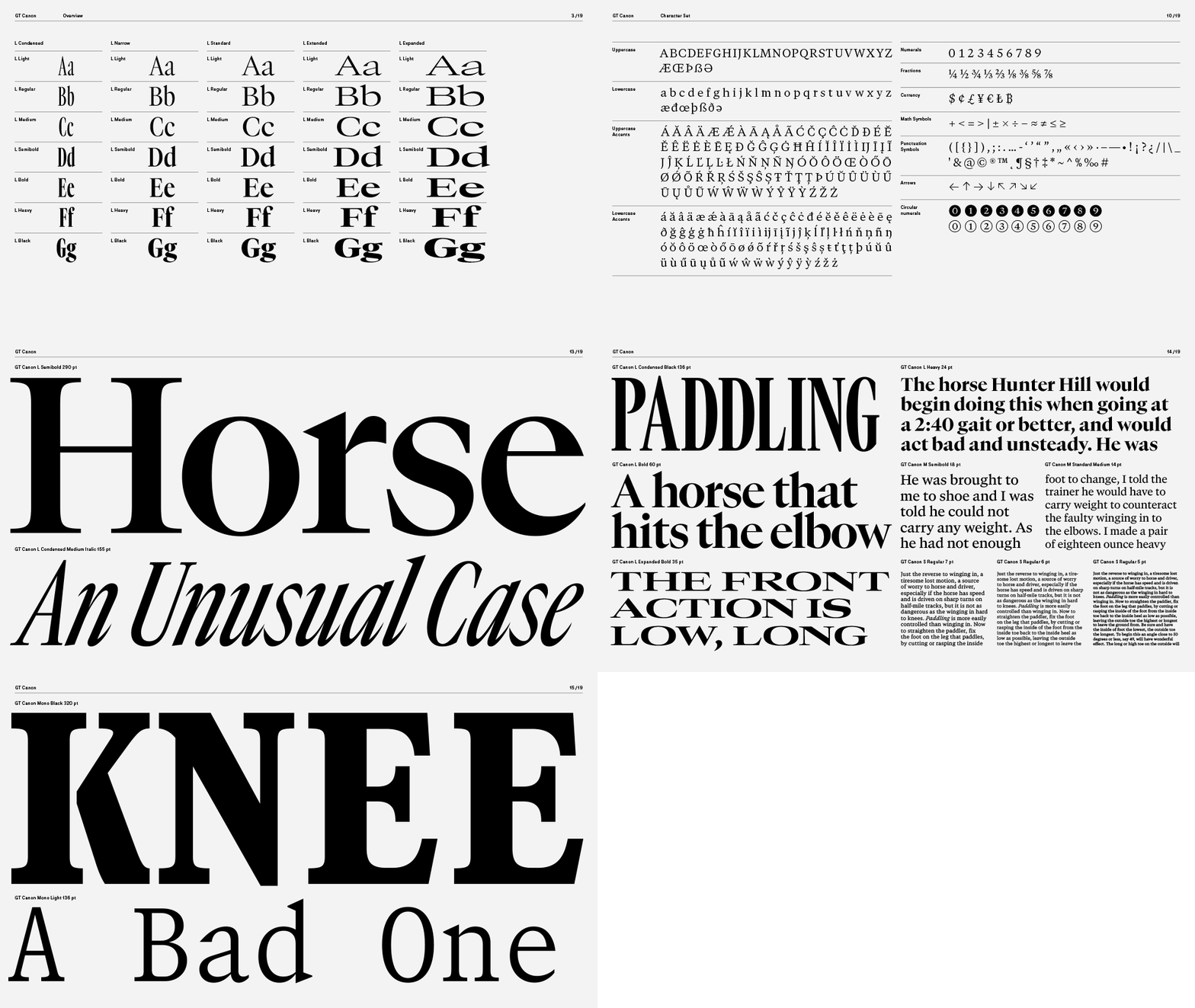
GT Canon’s design is pragmatic but not static: movement and liveliness are embedded in the letterforms. It is our answer to what our digital times require of a serif today. It’s what a contemporary serif should be in both form and function. Like its sans serif sibling, GT Standard, it aims for modern functionality rather than stylistic reinvention.
- Designed by Grilli Type
- Released in 2026
- Available in 224 styles
- GT Canon is available for customization and language extensions
- Download the free trial fonts
Typeface features
OpenType features enable smart typography. You can use these features in most Desktop applications, on the web, and in your mobile apps. Each typeface contains different features. Below are the most important features included in GT Canon’s fonts:
- TNUM
- Tabular figures
0123456789
- ONUM
- Oldstyle figures
0123456789
- SMCP
- Small Caps
Anatomy
Typeface Minisite
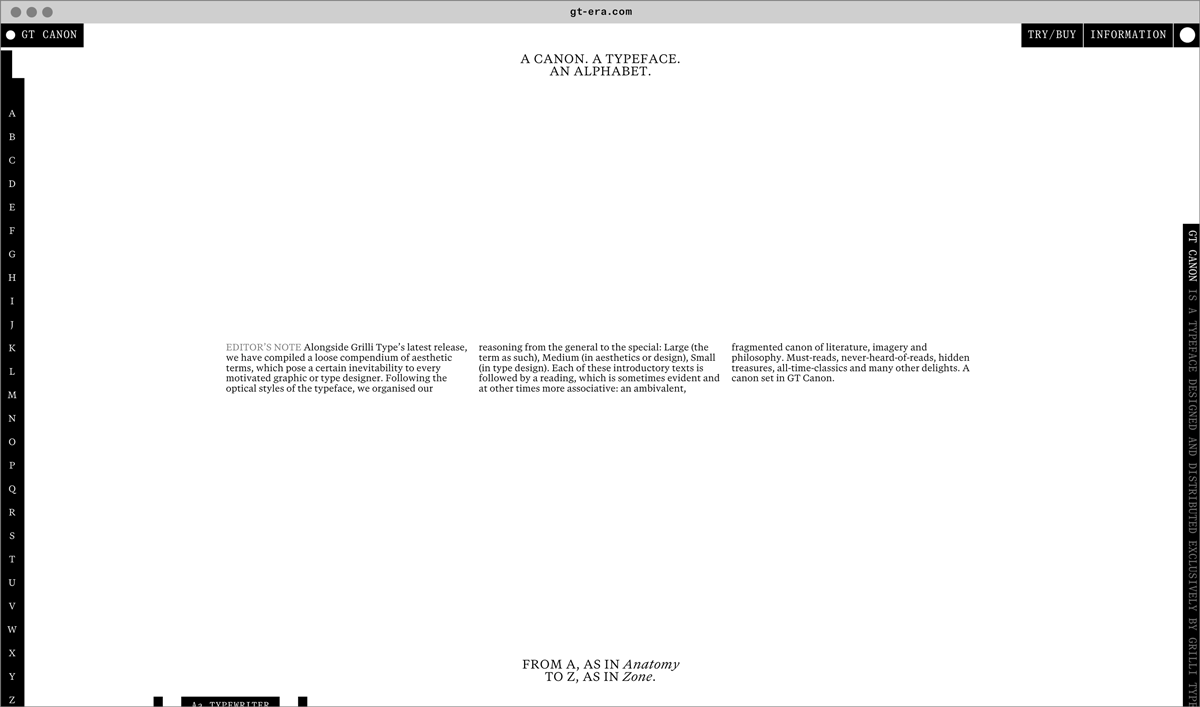
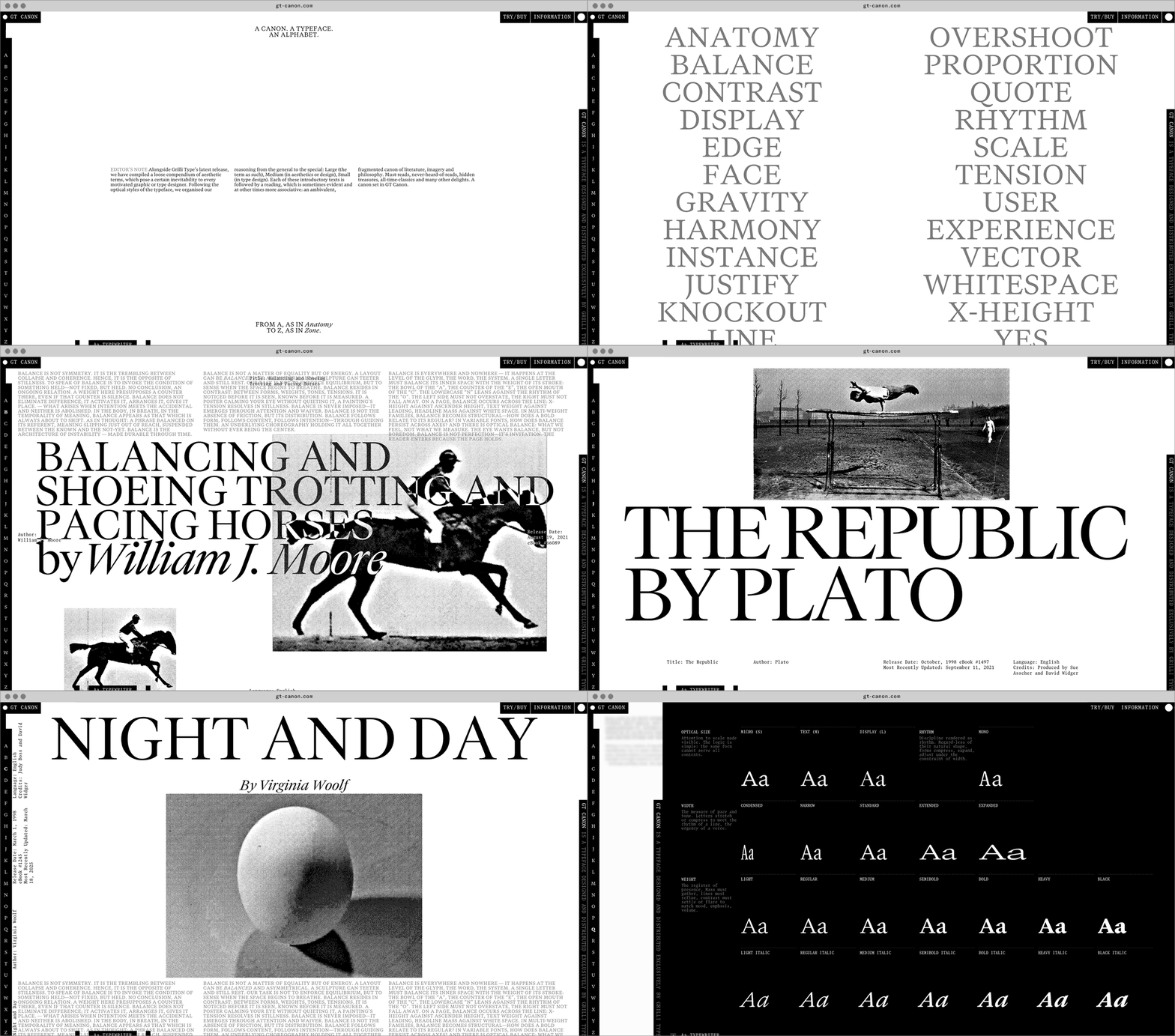
- Visit the GT Canon minisite to discover more about the typeface family’s history and design concept.
GT Canon in use