GT Mechanik
Family overview
- Mono
- Thin Oblique
- Light Oblique
- Regular Oblique
- Medium Oblique
- Bold Oblique
- Heavy Oblique
- Black Oblique
- Semi
- Thin Oblique
- Light Oblique
- Regular Oblique
- Medium Oblique
- Bold Oblique
- Heavy Oblique
- Black Oblique
- Poly
- Thin Oblique
- Light Oblique
- Regular Oblique
- Medium Oblique
- Bold Oblique
- Heavy Oblique
- Black Oblique
Subfamilies
- Semi ThinFeedback reintroduces output into the system as input, creating a recursive loop that stabilizes behavior through continuous adjustment rather than fixed control or static equilibrium.
- Semi Thin ObliqueSEMI configuration introduces partial separation within a system, allowing variation to exist without fully distributing across channels while maintaining a controlled degree of differentiation.
- Semi LightCALL SIGNS such as VQ9DM identify a transmission within a field of concurrent signals, enabling recognition of origin and continuity without disclosing the content that is being transmitted across distance.
- Semi Light ObliqueBecause 75 OHM impedance match aligns components within a transmission path to minimize reflection, ensuring continuity of signal across boundaries where mismatched conditions would otherwise produce loss.
- Semi RegularA circuit organizes movement into a closed path that both enables and constrains the flow of energy, distributing forces across a defined route in which every connection simultaneously allows passage and imposes limitation.
- Semi Regular ObliqueOne final reading confirms alignment within acceptable limits, indicating temporary stability within a system that remains subject to ongoing variation and recalibration.
- Semi MediumA two-way mode transmission requires reciprocal exchange between sender and receiver, transforming communication from broadcast into interaction where both sides participate in the production of meaning.
- Semi Medium ObliqueReception depends on alignment between sender and receiver, since even a strong signal fails to register when orientation or tuning is mismatched, making detection a function of compatibility rather than strength alone.
- Semi BoldAt 088 units on the scale, deviation becomes visible while remaining within tolerance, indicating measurable difference without exceeding the operational limits that define system stability.
- Semi Bold ObliquePOLY systems distribute signals across multiple channels, increasing structural complexity while enabling richer variation and interaction between simultaneous elements.
- Semi HeavyThe signal collapses variation into a single channel, reducing spatial differentiation while preserving continuity of content within a simplified transmission structure.
- Semi Heavy ObliqueUTC 0430 marks a synchronized point in time that coordinates systems without unifying their experience of duration, enabling alignment across distance.
- Semi BlackAn RST 5/9 report compresses reception quality into a standardized code, allowing variation in readability and strength to be communicated efficiently across operators using a shared framework of interpretation.
- Semi Black ObliqueFeedback reintroduces output into the system as input, creating a recursive loop that stabilizes behavior through continuous adjustment rather than fixed control or static equilibrium.
- Settings
Typeface information
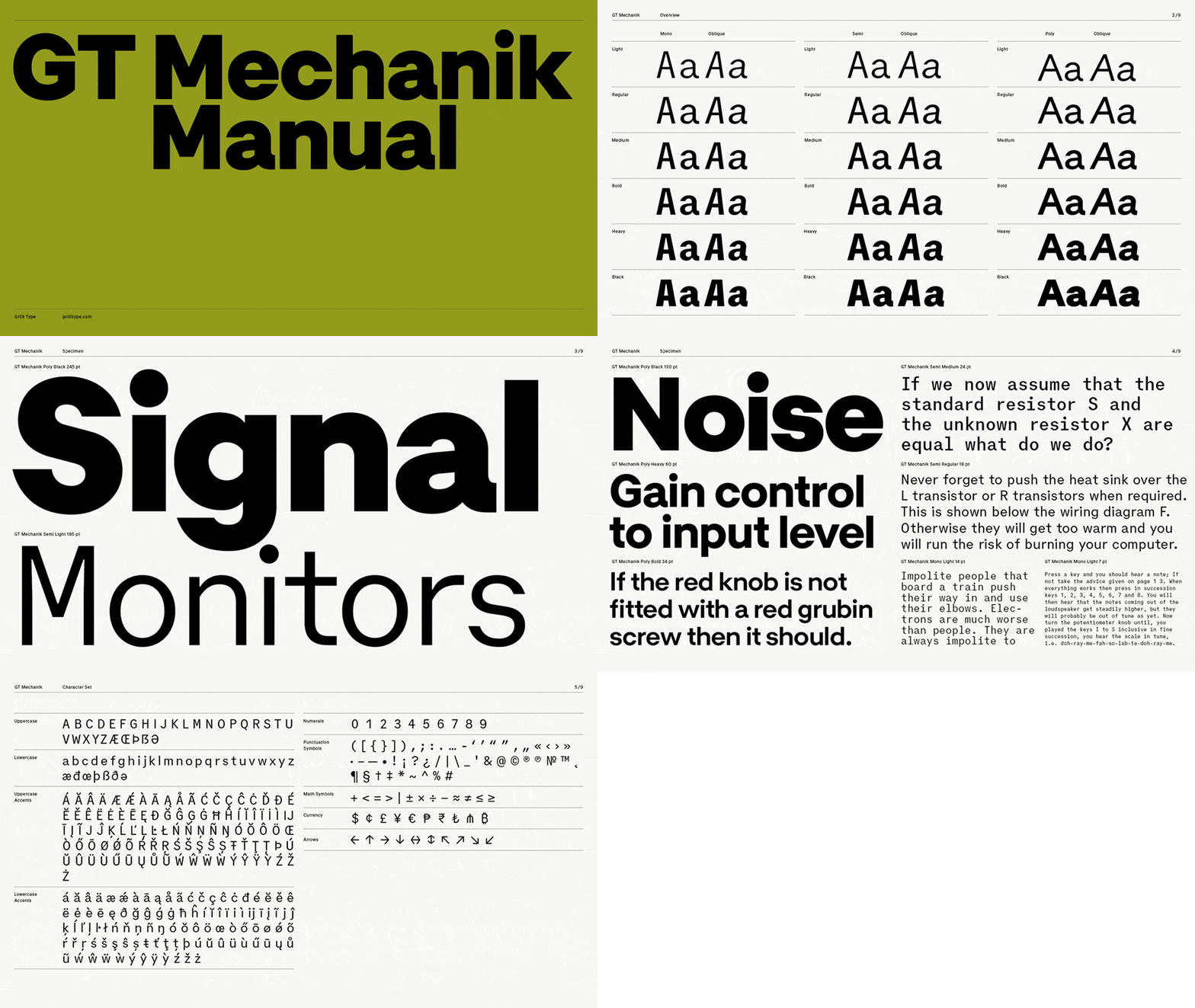
GT Mechanik dials in the appeal of electromechanical text systems by building an inevitable family around its monospace style. Idiosyncratic features that come with the restraints of mechanic typesetting become guiding principles along the tone axis. Mono, Text and Display, each follow that logic at a different scale and intensity.
- Designed by Shiva Nallaperumal, Reto Moser, Noël Leu
- Released in 2026
- Available in 42 styles
- GT Mechanik is available for customization and language extensions
- Download the free trial fonts
Typeface features
OpenType features enable smart typography. You can use these features in most Desktop applications, on the web, and in your mobile apps. Each typeface contains different features. Below are the most important features included in GT Mechanik’s fonts:
- TNUM
- Tabular figures
0123456789
Typeface Minisite
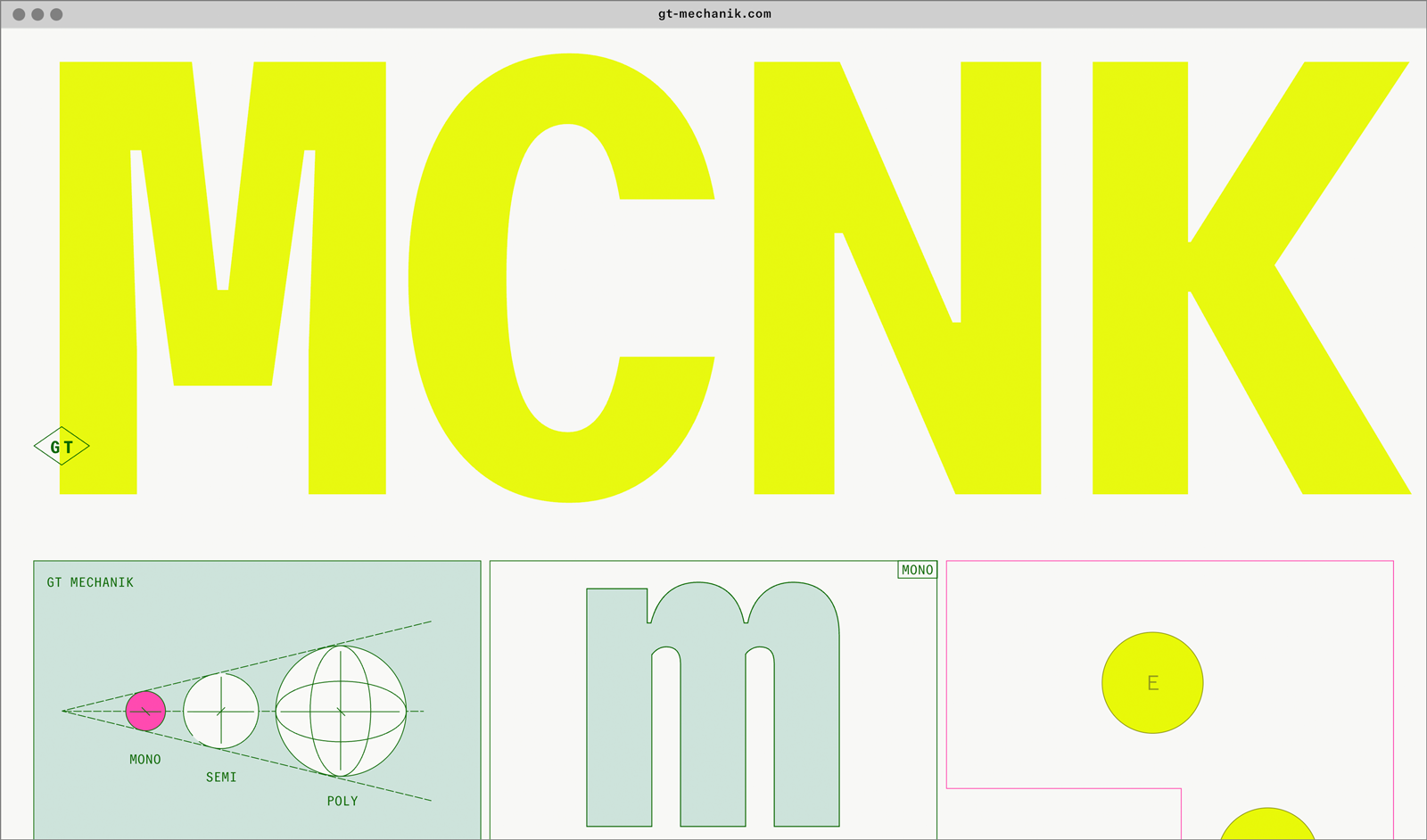
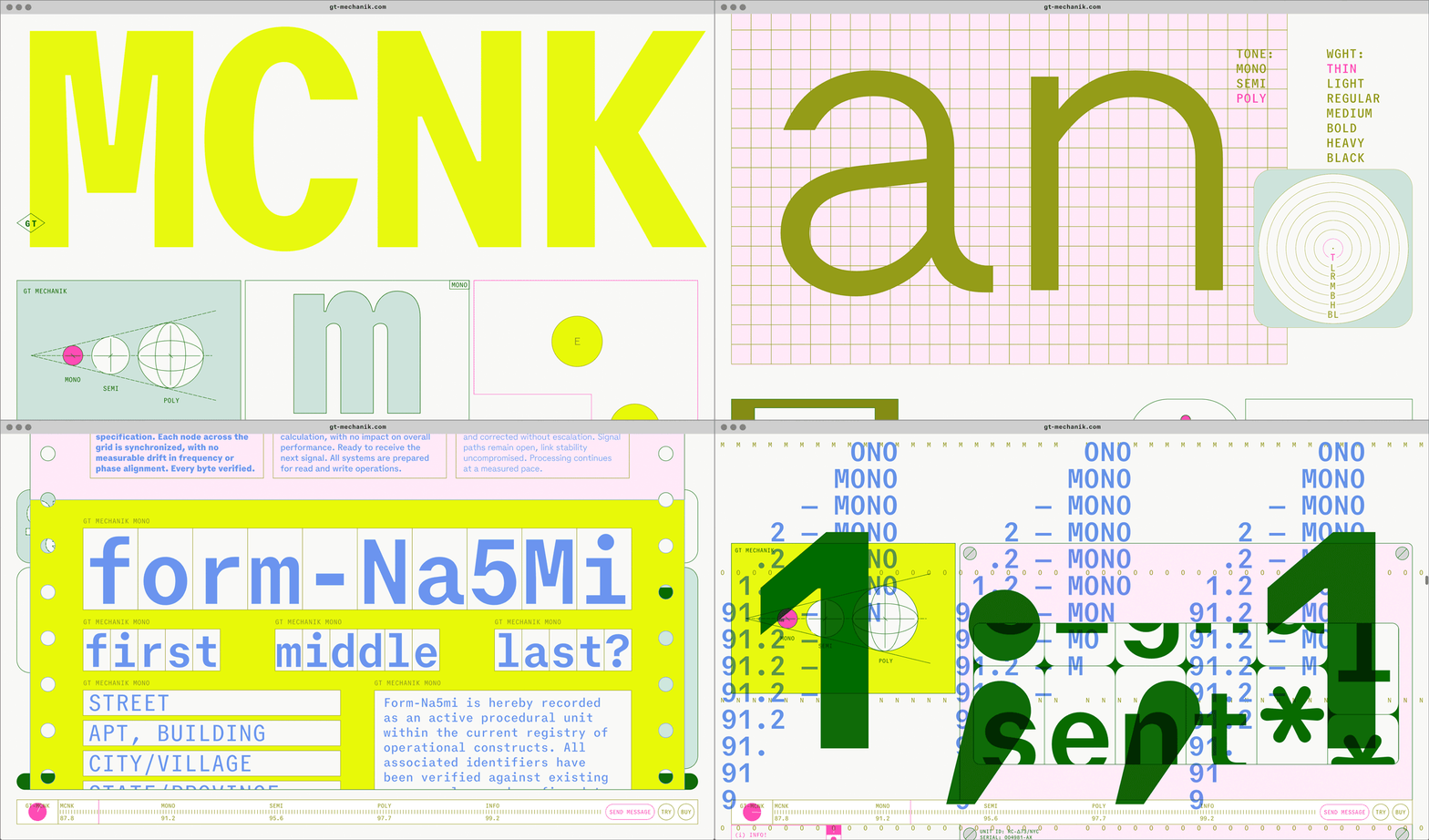
- Visit the GT Mechanik minisite to discover more about the typeface family’s history and design concept.