GT Mechanik

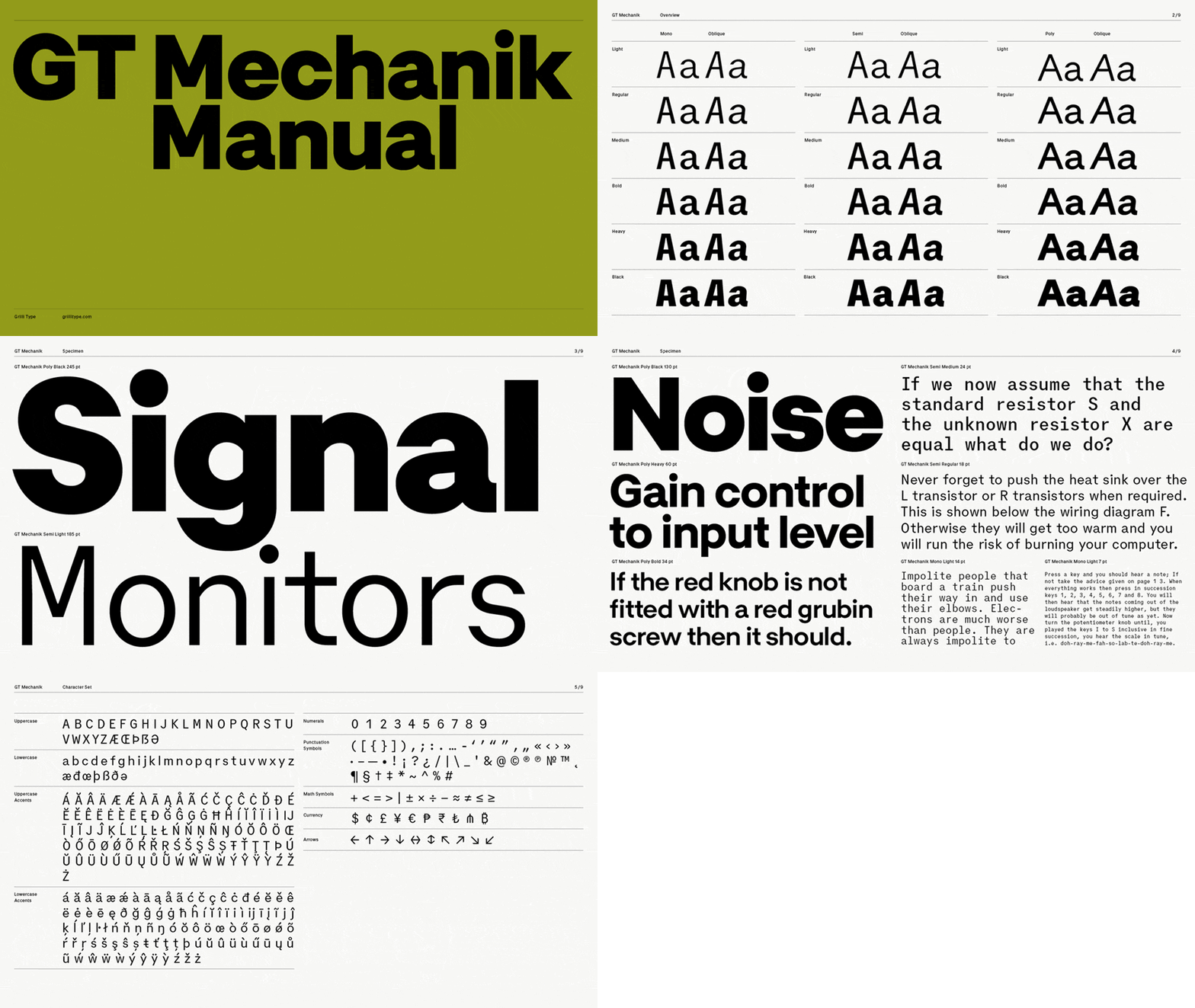
Family overview
- Mono
- Thin Oblique
- Light Oblique
- Regular Oblique
- Medium Oblique
- Bold Oblique
- Heavy Oblique
- Black Oblique
- Semi
- Thin Oblique
- Light Oblique
- Regular Oblique
- Medium Oblique
- Bold Oblique
- Heavy Oblique
- Black Oblique
- Poly
- Thin Oblique
- Light Oblique
- Regular Oblique
- Medium Oblique
- Bold Oblique
- Heavy Oblique
- Black Oblique
Subfamilies
- Semi ThinSettings dial translates rotation into measurable value, converting physical movement into abstract adjustment that can be read, repeated, and communicated across different instances of the same system.
- Semi Thin ObliqueThe signal collapses variation into a single channel, reducing spatial differentiation while preserving continuity of content within a simplified transmission structure.
- Semi LightReception depends on alignment between sender and receiver, since even a strong signal fails to register when orientation or tuning is mismatched, making detection a function of compatibility rather than strength alone.
- Semi Light ObliqueScale divides continuity into discrete units, making variation countable while imposing structure on a field that would otherwise remain fluid and unbounded.
- Semi RegularSignal strength measured in dB expresses magnitude in relation to a reference level, increasing perceptual presence without guaranteeing clarity when noise and distortion rise proportionally with amplification within the same system.
- Semi Regular ObliqueA measurement expresses the relation between a system and its reference, translating variation into comparable values that reflect calibrated agreement rather than absolute precision or fixed truth.
- Semi MediumAt 50 Hz, repetition stabilizes into a perceptible rhythm that establishes a baseline against which variations can be measured, creating a shared temporal structure that organizes perception within the system.
- Semi Medium ObliqueOur gain setting at +6 dB increases signal magnitude relative to a reference level, enhancing presence while maintaining proportional structure within the system.
- Semi BoldAMP measured in RMS values expresses magnitude independent of direction, reducing fluctuating signals to comparable metrics that can be evaluated consistently within a calibrated system.
- Semi Bold ObliqueFeedback reintroduces output into the system as input, creating a recursive loop that stabilizes behavior through continuous adjustment rather than fixed control or static equilibrium.
- Semi HeavyNew signals exist as a distinction within a field of variation, emerging only when they can be separated from surrounding noise through conditions of reception that define what counts as meaningful difference within a given system.
- Semi Heavy ObliqueAn RST 5/9 report compresses reception quality into a standardized code, allowing variation in readability and strength to be communicated efficiently across operators using a shared framework of interpretation.
- Semi BlackFrequency gives structure to time by dividing it into repeatable intervals that can be counted and compared, allowing different signals to share a common rhythm without requiring them to share the same content or origin.
- Semi Black ObliqueUTC 0430 marks a synchronized point in time that coordinates systems without unifying their experience of duration, enabling alignment across distance.
- Settings
Typeface information
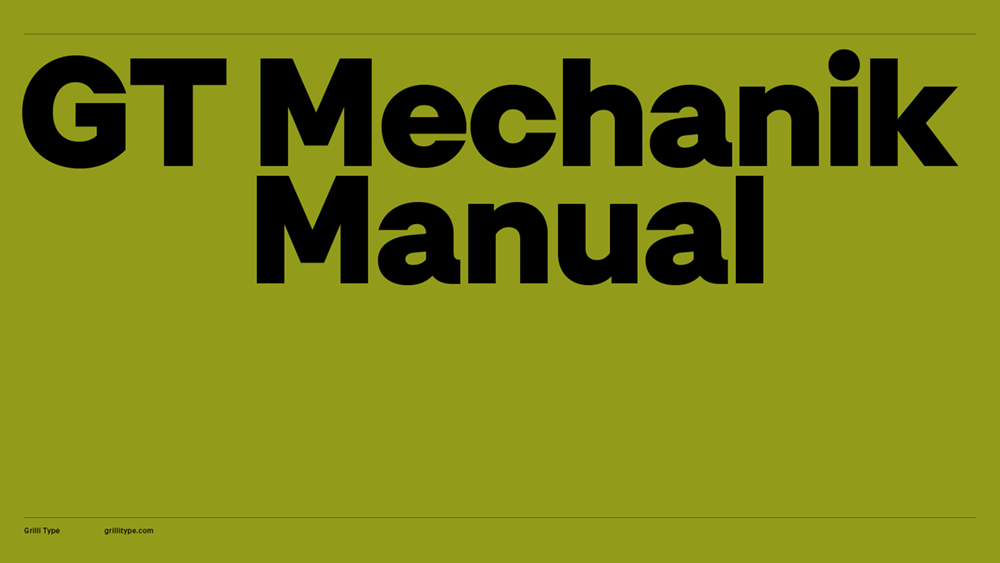
GT Mechanik dials in the appeal of electromechanical text systems by building an inevitable family around its monospace style. Idiosyncratic features that come with the restraints of mechanic typesetting become guiding principles along the tone axis. Mono, Text and Display, each follow that logic at a different scale and intensity.
- Designed by Shiva Nallaperumal, Reto Moser, Noël Leu
- Released in 2026
- Available in 42 styles
- GT Mechanik is available for customization and language extensions
- Download the free trial fonts
Typeface features
OpenType features enable smart typography. You can use these features in most Desktop applications, on the web, and in your mobile apps. Each typeface contains different features. Below are the most important features included in GT Mechanik’s fonts:
- TNUM
- Tabular figures
0123456789
Typeface Minisite
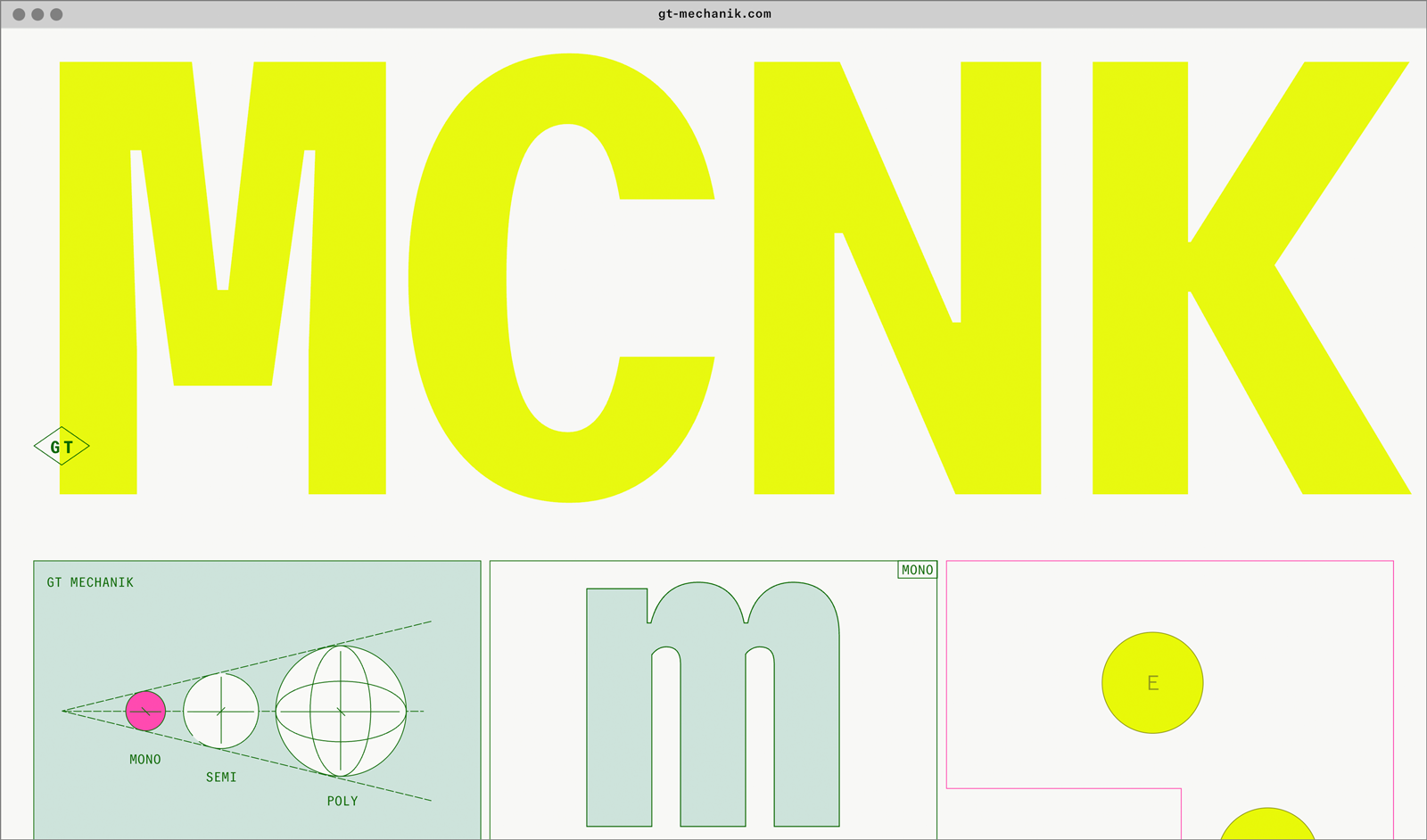
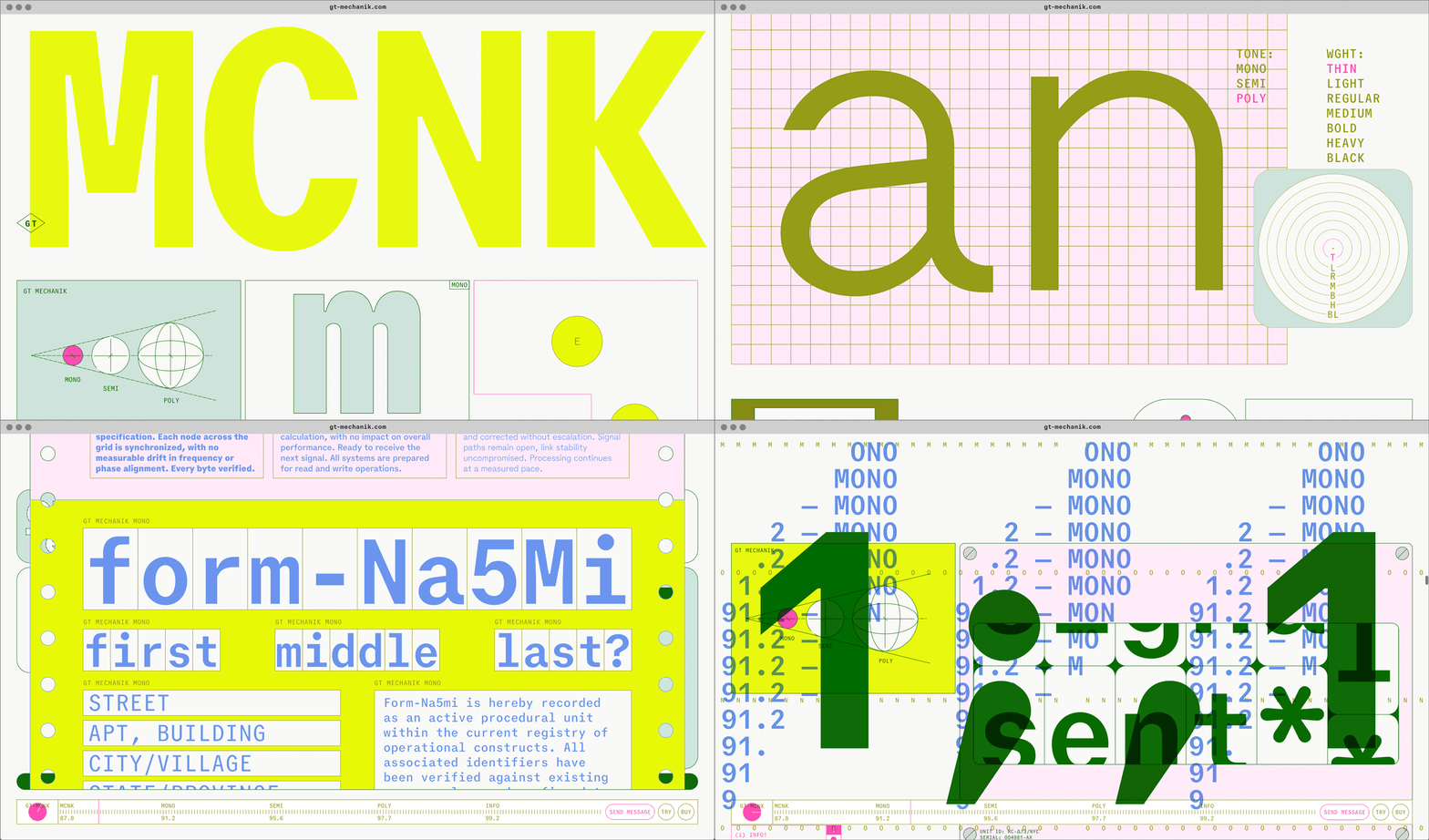
- Visit the GT Mechanik minisite to discover more about the typeface family’s history and design concept.